Cooktops
Viking Cooktop Repair for Gas Flames and Induction Glass
Gas and induction Viking tops drop into the same countertop opening, yet they break down for opposite reasons — one through ports, valves and sparks, the other through power boards and coils. Chicago Viking Masters repairs both, plus Viking electric radiant tops, for $89 per visit; you hear the repair figure once the fault is found.
Rated 4.9 by clients across 187 reviews Open the reviews page
Clicking that will not quit
Straight answer · 1/3
Why does my Viking cooktop keep clicking?
Nonstop clicking almost always means water or a spill has reached the spark switches or the spark module, often right after a wipe-down. Let the top dry fully with the burners off. If it still clicks once dry, a stuck switch on a valve stem or a failing module needs replacing.
Gas smell — stop here
If there is a gas odor, the cooktop can wait
Notice the smell of gas at the cooktop? Do not reach for a knob, a light switch, a lighter or the appliance plug — leave all of it alone. Get the family and any pets out the door, then call the gas company or 911 standing on the sidewalk. We come in to find the leak after they clear the space; the emergency page explains what happens next.
Six faults, two technologies
Symptom order
Some of these belong only to gas panels, some only to induction or radiant glass. The cause column says which part a technician puts the meter on first.
-
A gas burner sparks but never lights
Likely Ports clogged by boil-over, a cap resting off its seat, or an igniter tip cracked or coated in grease
-
Clicking continues after the flame catches or with every knob off
Likely Moisture inside the spark module after a spill or a heavy cleaning, or a spark switch on one valve stem that has stuck closed
-
The flame is small, uneven or lifts away from the burner
Likely Partly blocked ports, a misaligned cap, or a supply pressure problem the technician measures at the cooktop
-
An electric or induction zone stays cold
Likely On radiant tops a broken element, a failed control switch or loose wiring; on induction a power board, a coil or the electronics that detect the pan
-
A gas odor near the panel
Likely A fitting, seal or valve letting gas past — the red notice above comes first, diagnosis after
-
A knob spins loosely, sticks or will not stay at simmer
Likely A worn or stripped valve stem, a cracked knob insert, or grease packed around the stem below the knob
Induction is an electronics repair
Straight answer · 2/3
Do you repair Viking induction cooktops?
Yes. On a Viking induction cooktop the usual faults are a power board, an induction coil under one zone, or the electronics that sense the pan. Each gets metered, you learn which one died, and a firm quote comes ahead of the work. Coming out costs $89.
Gas burners next to induction glass
Two cooktops, one brand, very different insides. Here is how a diagnosis changes between them.
Option A
Gas cooktop with sealed burners
- Mechanical faults dominate: clogged ports, worn valves, cracked igniters.
- Water and spills are the most common trigger for clicking and dead sparks.
- The technician watches the flame — color, height and shape — as a diagnostic tool.
- Every connection disturbed during a repair is leak-tested before we leave.
Option B
Induction cooktop
- Faults are electronic: power boards, coils, pan sensing and the touch controls.
- Heat, steam and a crowded cabinet below can stress the cooling fan and boards.
- Diagnosis is done with a meter and the cooktop's own response, zone by zone.
- Glass damage is assessed separately, since a cracked top changes the decision.
Our call
Both are worth a diagnosis before anyone talks about replacement — a single failed part is the most common finding on either.
After a gas repair: leak test and flame check
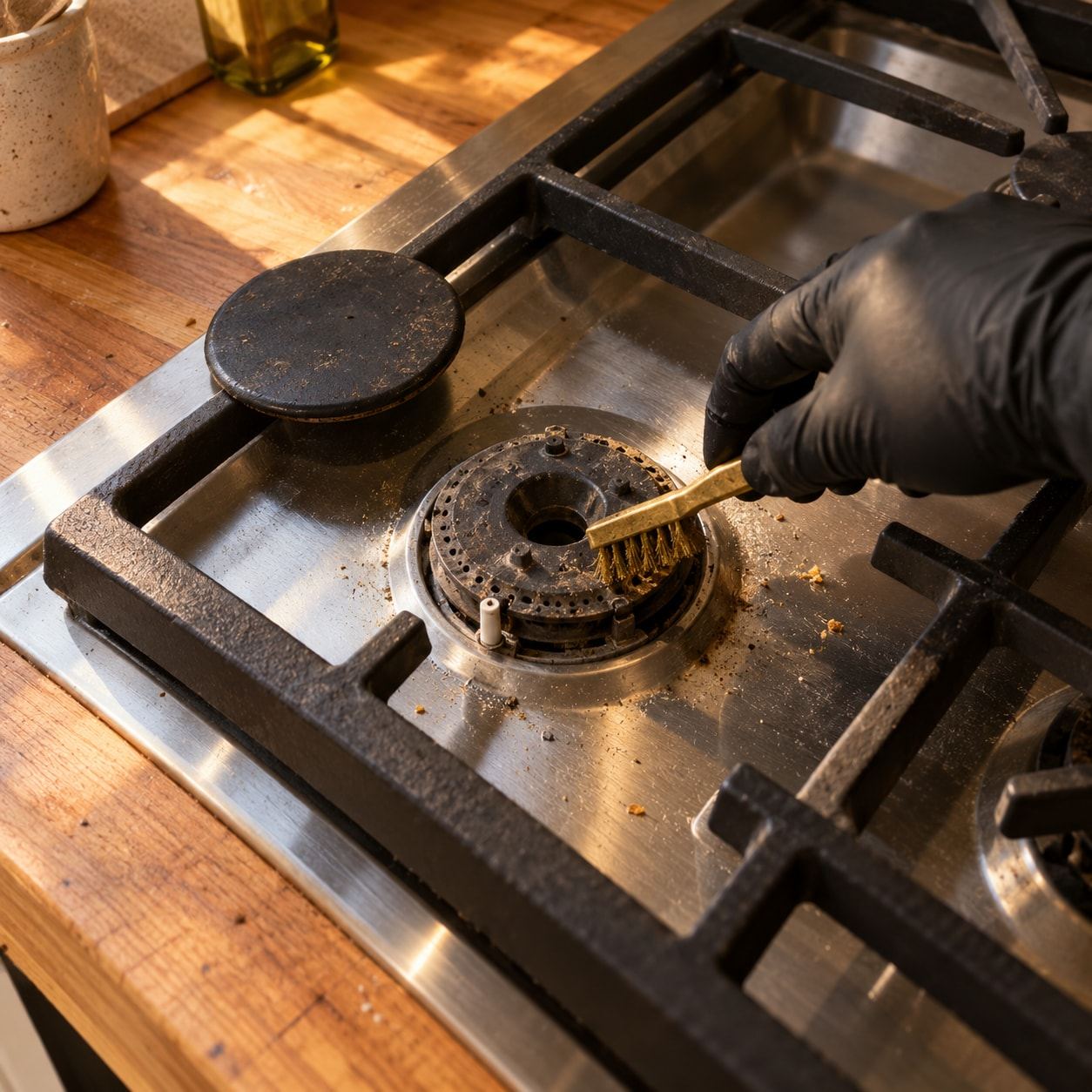
A gas cooktop repair is not finished when the new igniter sparks. Any time a technician opens a burner box, swaps a valve or reseats a supply fitting, the joints that were touched are tested for leaks with the gas on. That check happens with the cooktop in place, before caps and grates go back.
Then every burner is lit and watched. A healthy sealed burner shows a steady blue ring with even height all the way around and no yellow tips dancing off the edge. A lopsided flame after a repair usually means a cap is not seated or a port is still partly blocked, and it is corrected on the spot rather than left for you to find at dinner.
Last, the simmer setting is checked on each burner, because a valve that holds high flame can still fail to hold a low one. Only when every burner lights, burns clean and turns down properly does the technician sign off. If the cooktop sits under a Viking hood that also needs attention, the ventilation page covers what we do there.
Repair or replace: what decides it
What moves the price
Apart from the $89 trip, this page carries no numbers: the fix is priced on what turns up. Below is what pushes that figure up or down, and what tips a top toward repair or toward replacement.
- Which part failed
- An igniter or a spark switch is a small, contained repair. A power board on induction or a set of valves on gas is a bigger one.
- Gas, radiant or induction
- Mechanical gas repairs and electronic induction repairs use different parts and take different testing.
- Age and condition of the cooktop
- A useful rule of thumb: if the cooktop is younger than 15 years and one specific component has failed, repair usually makes more sense than replacement.
- The glass
- On radiant and induction tops, a cracked or chipped surface is a separate problem from a failed element or board and is weighed on its own.
- Part availability
- Frequent wear items often travel with the technician; anything unusual gets ordered and fitted during a second call.
Straight answer · 3/3
Should I repair or replace my Viking gas cooktop?
Repair is usually the better choice when the cooktop is still sound and one part has failed — an igniter, a spark module, a valve or a knob stem. Replacement starts to make sense when several valves are failing together or the burner box is corroded. A diagnosis tells you which case you are in.
Cooktop questions from the people who cook on them
- Can you convert my Viking cooktop from natural gas to propane?
- Yes. A propane conversion means swapping the burner orifices and setting the regulator for the new fuel. Call with the model number first so the right parts are confirmed before the visit.
- Can I keep cooking while the igniters keep clicking?
- With no gas odor and burners that catch normally, the noise is annoying, not hazardous. Keep the top dry and avoid spraying cleaner onto the burners. If it does not stop after drying, book a visit.
- How much does Viking cooktop repair cost?
- Bringing a technician out is $89, and that goes against the final bill. The repair gets a fixed figure once the fault is located, ahead of any work. How we price explains the variables.
- My cooktop and my wall oven both have problems — one fee or two?
- One. We charge $89 per trip, not per appliance — the cooktop, the oven and anything else Viking in your kitchen can be checked during that single call.
- When should I stop troubleshooting and call?
- Once the top is dry, caps are seated and the problem remains — or right away if a knob spins freely or a zone stays cold. Our guide on when to call a Viking technician lists the signs that need a professional.
Order up
Stop the clicking, bring back the flame
Lines are open 24/7; technicians are out 8 AM–6 PM daily. A single $89 call covers the cooktop plus whatever other Viking appliances need a look.
$89 service call: one flat trip charge, whether the technician opens up a single Viking or every Viking in the kitchen; that sum then comes off the repair total if you sign off on the work.